
Our teachers and children should be looking to the skies but thanks to screens and lack of means in our centralised world they are becoming dead behind the eyes.
Thanks for the next 5 minutes of your valuable time let’s cut to the chase with a magpieing style EcoLearn CIC Education Briefing for Autumn Term
In this high 5 feeling alive issue:
- The Core Philosophy: Why Paper, Trowels, and Water Beat EdTech Gimmicks
- Early Years & Key Stage 1–2 In Action: Hands-On Enquiry That Sticks
- Closing the Loop: Heritage Seeds & Living Assets in the School Ground
- Rainwater Harvesting & School SuDS: Engineering, Geography, and Nature in Real Time
- Practical Next Steps: Equipping Your Staff for Spring Term
1 Hands-On Enquiry: Why Trowels Beat Screens
There is a strange orthodoxy in modern education that every complex idea requires a tablet screen. Yet when it comes to understanding natural cycles, biology, and climate resilience, screens isolate pupils from the very physical relationships they are supposed to understand.
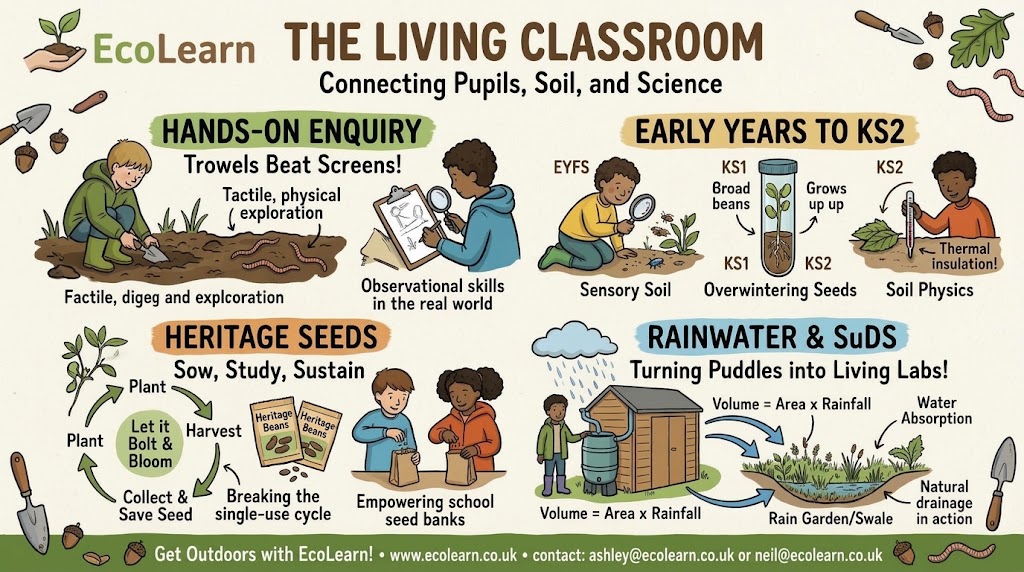
Real ecological literacy does not happen via an interactive whiteboard. It happens when six-year-olds dig into cold, damp topsoil to feel texture and structure, when year fours build an open rain garden to stop tarmac runoff, and when year sixes track seed germination rates with a pencil and a paper clipboard. We believe sketch-mapping and physical measurement build deeper foundational retention of primary science than any another slide deck ever will.
2 Early Years, KS1 & KS2: Direct Curriculum Enquiries
Practical outdoor science translates directly into statutory primary learning objectives across three key stages:
- Early Years Foundation Stage (EYFS) — Sensory Soil & Micro-Habitats: Young learners take magnifying lenses and trowels directly into the leaf litter and compost corners. By physically handling soil textures and observing earthworms, woodlice, and decomposing organic matter, children hit core Understanding the World objectives through immediate, tactile exploration of living things and seasonal change.
- Key Stage 1 — Plant Life & Overwintering Seeds: Pupils plant cold-tolerant heritage broad beans into clear root tubes and planters. Rather than looking at a diagram in a textbook, they sketch the emergence of roots versus shoots week by week. This satisfies KS1 Science (Plants & Seasonal Change) by grounding the basic requirements for germination and plant survival in direct physical observation.
- Key Stage 2 — Soil Physics, Insulation & Water Permeability: Older primary pupils step into active scientific testing by inserting soil thermometers at 5cm depths beneath bare earth compared to heavily mulched beds. Alongside this, they run percolation tests across gravel, clay, and compost to map permeability and runoff. This directly meets KS2 Science (Living Things, States of Matter) and Geography criteria, teaching thermal mass, microclimates, and physical hydrology in real time.
3 Open-Pollinated Heritage Seeds: Breaking the Single-Use Model
Most school gardens inadvertently teach consumer dependency. Packets of hybrid F1 seeds are bought each spring, planted, harvested, and discarded—requiring schools to buy new packets every single year.
The Sow Study Sustain model breaks this cycle by introducing open-pollinated heritage varieties:
- The Complete Biological Cycle: Children don’t stop at harvesting vegetables. They leave chosen specimens to flower, set seed, dry out, and be harvested.
- Seed Sovereignty & Living Assets: Pupils clean, weigh, packet, and store seeds in a school seed bank for the following year’s intake.
- Embedded Numeracy: Calculating germination percentages, seed viability ratios, and seed-to-yield weights turns arithmetic into tangible food metrics.
4 Rainwater Harvesting & SuDS: Turning Puddles into Living Labs
School grounds are frequently plagued by waterlogged play areas or flash runoff rushing straight down storm drains. Implementing basic Sustainable Drainage Systems (SuDS) and gravity-fed rainwater harvesting transforms an infrastructure headache into a continuous primary teaching asset:
- Water Attenuation in Action: Pupils track water collected from shed and canopy roofs into water butts and rain planters, calculating rainfall volume ($Volume = Area \times Rainfall\ Depth$) during weather units.
- Mini Rain Gardens: Constructing shallow, planted swales filled with native riparian plants demonstrates how soil and vegetation slow the flow, filter silt, and prevent local flooding.
- Micro-Hydrology & Habitats: Watching rain move through gravel pathways, sand beds, and mulch demonstrates groundwater recharge, soil absorption, and seasonal pond formation right outside the classroom door.
5 Equipping Your School: CPD, Toolkits & Planning
Taking science outside should alleviate pressure on classroom teachers, not add administrative weight. EcoLearn partners with primary schools, trust leads, and science coordinators to establish low-maintenance, high-impact outdoor study spaces:
- Curriculum-Linked Enquiry Kits: Weather-resistant observational templates, field data sheets, and structured lesson plans designed for the primary science timetable.
- Site Audits & SuDS Planning: Evaluating grounds to install productive raised beds, seed hubs, and simple rainwater diversion systems that run year-round.
- Teacher Inset & Twilight Training: Hands-on sessions delivering risk-managed, practical outdoor confidence for teachers across all Key Stages.
SPECIAL OFFERS – summer sales extended

Let’s Connect
Whether you are looking to install a dedicated heritage growing space, build a school rain garden, or upskill your teaching team for the spring term, we would welcome a conversation.
- Web: [ecolearn.co.uk]
- Email: neil@ecolearn.co.uk or ashley@ecolearn.co.uk
- Book an outdoor enquiry audit or enquire about primary heritage seed packs ashley@ecolearn.co.uk